

Planned. Guaranteed Blockspace is a forward-looking roadmap item. See Roadmap for timing.
Why this matters
General-purpose chains weren’t designed for fee predictability under load:- Ethereum: on May 1, 2022, the Yuga Labs “Otherside” NFT mint pushed peak gas above 8,000 gwei and burned over $200M in fees, breaking any workload that required deterministic cost.
- Low-fee networks like Solana and Base attract MEV and arbitrage spam, so legitimate transactions compete with bot traffic for inclusion.
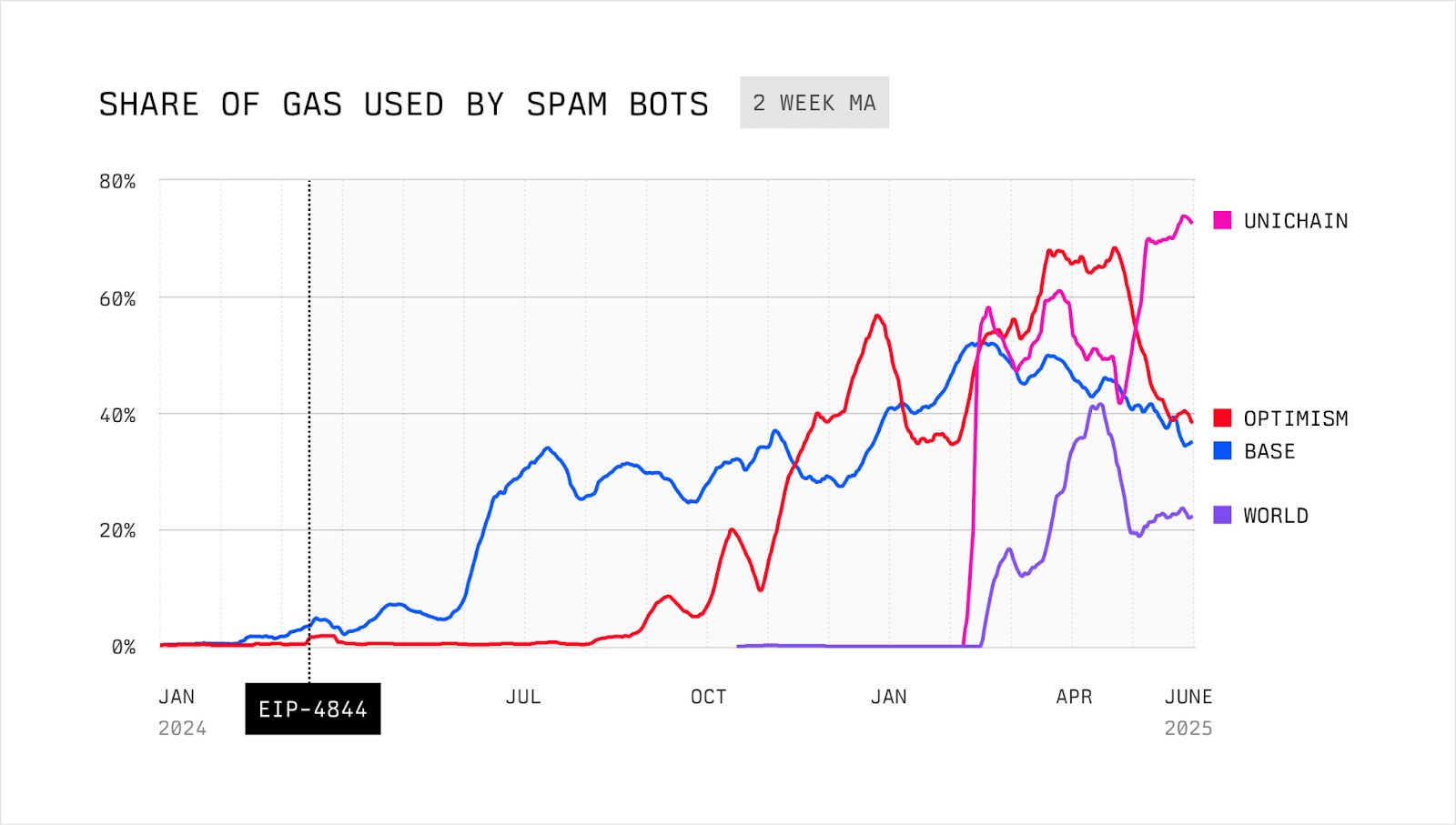
Source: MEV and the Limits of Scaling by Flashbots and Robert Miller
How the guarantee works
The guarantee is enforced at three layers:- Guaranteed mempool: validators pull guaranteed transactions from a dedicated mempool, isolated from public traffic.
- Validator-level reservation: each validator reserves a predefined portion of every block’s gas capacity for the guaranteed lane. Deterministic inclusion falls out of this.
- Dedicated RPC nodes: the Guaranteed Blockspace API routes transactions through isolated RPC endpoints, so submission latency doesn’t spike with public RPC load.
- Exclusive routing path: submissions don’t compete with public mempool traffic.
- Guaranteed inclusion: capacity is reserved in every block regardless of network congestion.
- No decentralization trade-off: validator openness and network participation are preserved; the guarantee lives alongside the public lane, not above it.
- Reliable on-chain performance for business-critical operations, even under load.
Next recommended
Guaranteed settlement
See the payment pattern that depends on guaranteed blockspace: timed DvP settlement cycles with deterministic inclusion.
USDT as gas
Understand the asset that flows through guaranteed blockspace.
Tokenomics
Review how STABLE staking underpins validator blockspace guarantees.